Stronger in the Shadows: How Scott Tennant's Collaborative Work Reveals His Deepest Artistry
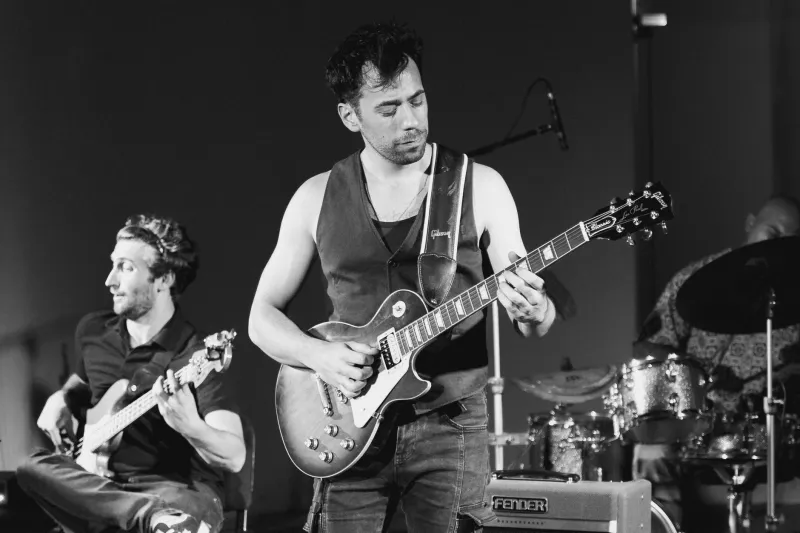
There's a persistent myth in music — and really in any creative field — that greatness is measured by how much space you occupy. The bigger the solo, the longer the spotlight, the more you matter. Scott Tennant has spent a career quietly dismantling that idea, not through grand declarations, but through the simple, undeniable evidence of his collaborative work.
When Tennant steps into an ensemble setting, something shifts. The edges of his playing soften in all the right places. The ornamentation becomes less about display and more about dialogue. And somehow, in giving up the center, he ends up saying more.
The Paradox That Defines His Best Work
It sounds counterintuitive, but the projects where Tennant isn't the designated star tend to be the ones fans return to most. There's a reason for that. When you're the featured soloist, the pressure to deliver something singular — something definitively you — can actually narrow the emotional range of your playing. You're performing identity as much as music.
But when Tennant slides into a supporting or complementary role, that pressure dissolves. What replaces it is something richer: genuine listening. Real-time responsiveness. The kind of musical conversation that only happens when everyone at the table is actually paying attention to each other instead of waiting for their turn to speak.
Guitar, as an instrument, is uniquely suited to this kind of work. Its tonal range is wide enough to function as melody, harmony, rhythm, or texture depending on what the moment demands. Tennant understands this flexibility better than almost anyone working in classical guitar today, and his ensemble playing reflects that fluency in ways that are hard to fake.
Serving the Score, Not the Ego
One of the clearest windows into Tennant's collaborative philosophy is how he approaches repertoire that wasn't written with him as the focal point. Whether he's working within a chamber ensemble or lending his guitar to a larger compositional framework, his instinct is always to serve the architecture of the piece rather than impose himself on it.
This is rarer than it sounds. Plenty of technically accomplished musicians bring their full toolkit to every situation regardless of whether the music calls for it. Tennant has developed the discipline — and honestly, the confidence — to hold back. To let a rest breathe. To let another voice carry the melodic weight while he lays down something subtle underneath that makes the whole thing feel more grounded.
That restraint is a skill. And it's one that takes years to develop, because it requires trusting that your contribution matters even when it isn't the most obvious thing in the room.
What His Collaborators Bring Out in Him
It's also worth acknowledging the role that strong collaborators have played in shaping some of Tennant's most memorable moments. The best musical partnerships are genuinely reciprocal — they change both parties. When Tennant works alongside musicians who challenge him, who have their own strong aesthetic instincts and aren't afraid to push back, the results tend to carry a kind of creative tension that solo work simply can't replicate.
That tension isn't conflict. It's more like the productive friction that happens when two intelligent perspectives meet and have to find common ground. The music that emerges from that negotiation has a different quality to it — less polished in a sterile sense, more alive in a human one.
Fans who've followed Tennant's career closely have noticed this pattern. The recordings and performances that tend to generate the most sustained conversation aren't always the showcase pieces. They're often the collaborative efforts, the chamber recordings, the moments where he's one voice among several and the interplay between them becomes the real story.
Restraint as a Form of Generosity
There's something almost countercultural about what Tennant models through his ensemble work, especially in a music landscape that still tends to reward maximalism. Knowing when not to play — when to leave space for someone else, when to simplify your part so the texture of the whole becomes clearer — is an act of generosity as much as it is a musical decision.
And audiences feel it, even if they can't always articulate why. There's a warmth to collaborative performances where everyone is genuinely serving the music rather than themselves. It creates a sense of trust between the performers and the listener. You feel like you're being let into something real rather than watching a demonstration.
Tennant's approach to collaboration communicates that he's thought seriously about what music is actually for. It's not a vehicle for proving technical superiority. At its best, it's a way of connecting — with other musicians, with an audience, with the emotional truth of a piece of writing that someone poured themselves into.
The Lesson Hiding in Plain Sight
For anyone studying Tennant's career arc, his collaborative work offers a lesson that's easy to overlook precisely because it doesn't announce itself. It doesn't come with a flashy technique or a record-breaking passage. It comes in the form of a perfectly placed accompaniment, a line that supports without overwhelming, a musical choice that says I heard you more clearly than any virtuosic display ever could.
That's the paradox at the heart of his ensemble work: by choosing to be less, he consistently becomes more. More present, more expressive, more essential to the music happening around him.
For an artist with Tennant's technical gifts, that choice isn't a limitation. It's a statement. And it might be the most sophisticated thing he does.