Give and Take: The Unspoken Rules Scott Tennant Lives By When He's Someone Else's Sideman
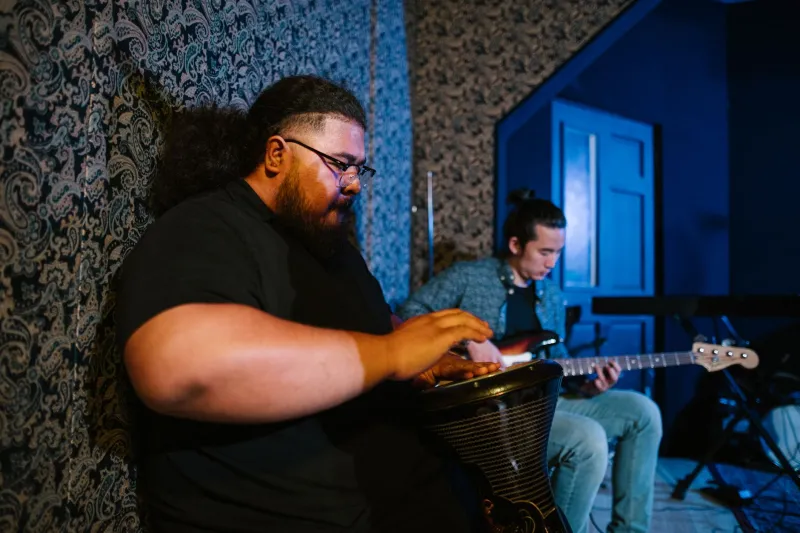
There's a certain kind of musician who walks into a session and immediately tries to own it. Then there's the kind who reads the room, figures out what's actually needed, and delivers something so perfectly placed that the whole track lifts. Scott Tennant is firmly in the second camp — and that quality has made him one of the most sought-after collaborators in the classical guitar world.
But collaboration isn't just a career strategy for Tennant. It's closer to a personal code. The way he approaches working with other artists reveals as much about his character as any solo recording he's ever made.
The Rare Skill of Listening Before Playing
Most musicians learn technique. Fewer learn restraint. Tennant, who spent years developing one of the most technically refined approaches to classical guitar in the country, could easily walk into any ensemble setting and dominate. He chooses not to.
What sets him apart in collaborative contexts is an almost instinctive ability to diagnose what a piece — or a fellow artist — actually needs. Sometimes that's a bold, textured line that anchors the whole performance. Other times it's a barely-there accompaniment that gives a vocalist or co-instrumentalist the space to breathe and shine. Tennant seems to understand, maybe better than most, that the best collaborators are often the ones you notice least — until you pull them out and suddenly something feels missing.
This isn't passivity. It's a sophisticated form of musical intelligence that takes years to develop.
Cross-Genre Moments That Turned Heads
Tennant's collaborative work hasn't been confined to the classical sphere. Over the course of his career, he's crossed into territory that surprised even longtime fans — and each time, he managed to bring something identifiably his without overshadowing the project's original vision.
When working alongside artists from folk, world music, or contemporary composition backgrounds, Tennant has shown a flexibility that's genuinely rare. He doesn't abandon his classical foundation — the precision, the tonal control, the architectural sense of phrasing — but he bends it toward whatever sonic landscape the collaboration requires. The result is a contribution that feels both foreign and familiar, like a new ingredient that somehow makes a recipe taste more like itself.
Think about the challenge there: you're entering someone else's creative world. You're working with their vocabulary, their tempo, their emotional intent. And yet, if you listen carefully to Tennant's featured appearances, you can always find him in there. A particular attack on a note. A dynamic choice that only he would make. It's subtle, but it's consistent — and that consistency is what makes a collaborator trustworthy.
What He Brings to Ensemble Work
In ensemble settings, Tennant functions as something of a musical anchor. His technical precision gives other performers something solid to lean against, and his sensitivity to dynamics means he's never fighting for space in the mix. Fellow musicians have described working with him as unusually comfortable — the kind of session where you feel supported rather than competed with.
That comfort isn't accidental. Tennant has spoken, in various interviews and masterclasses, about the importance of ego management in collaborative work. The idea that your individual voice matters less than the collective sound. That's easy to say and genuinely hard to practice, especially for artists who've spent decades building a distinct personal style. For Tennant, it seems to come naturally — or at least, he's done the internal work to make it look that way.
His time at USC's Thornton School of Music, where he's taught for years, has probably deepened this. Teaching forces you to subordinate your own preferences to the needs of another person's development. You start to see how many ways there are to arrive at musical truth. That kind of perspective doesn't stay in the classroom.
Staying True While Serving the Vision
Here's the tension at the heart of any serious collaboration: how do you contribute meaningfully without losing yourself? Too much deference and you become a ghost — technically present but artistically invisible. Too much self-expression and you're just doing your solo act in someone else's space.
Tennant navigates this better than almost anyone in his field. The key seems to be that he never fully separates "his sound" from "the project's sound." He finds the overlap — the place where what he does naturally also happens to serve what the music needs. That's not compromise. That's craft.
It's also, frankly, a confidence thing. Artists who are insecure about their identity tend to either overassert or disappear. Tennant's decades of solo work have given him such a clear sense of who he is as a musician that he can afford to be generous in collaborative contexts. He doesn't need to prove anything. That freedom shows.
Why Other Artists Keep Calling
If you want to understand why Tennant keeps getting invited into other people's projects, look at the results. Tracks and performances he's contributed to tend to have a certain quality — a groundedness, a clarity — that's hard to fake and harder to manufacture after the fact.
But beyond the sonic results, there's something about the experience of working with him that artists seem to value. He shows up prepared. He communicates clearly. He respects the vision without being a pushover about his own ideas. In a world where creative collaborations can easily devolve into ego clashes or miscommunication spirals, that combination is genuinely rare.
It also doesn't hurt that he's one of the finest classical guitarists alive. Talent, ultimately, is what opens the door. Character is what keeps it open.
The Bigger Picture
Scott Tennant's collaborative work is, in many ways, an extension of everything that defines him as a solo artist — the discipline, the sensitivity, the refusal to take shortcuts. But it also reveals a dimension of his artistry that pure solo recordings can't fully capture: his ability to connect, adapt, and elevate.
In an era where "collaboration" often just means two famous names on a playlist, Tennant represents something more genuine. He actually listens. He actually responds. And in doing so, he reminds everyone in the room — and everyone listening — what musical partnership can look like when it's done right.