Fingerprints on the Fretboard: Breaking Down the Technical Signatures That Make Scott Tennant's Playing Unmistakable
There's a moment — usually a few seconds into hearing Scott Tennant play — where something clicks. You can't always name it right away, but there's a texture, a weight, a sense of control that feels different from anyone else holding a classical guitar. That's not an accident. It's the result of years of deliberate, methodical craftsmanship layered into every single performance decision he makes.
For fans who want to go deeper than "he's just really good," this one's for you. We're breaking down the actual technical elements — the mechanics, the instrument choices, the sonic fingerprints — that define Scott Tennant's artistry.
The Right Hand: Where the Sound Actually Lives
In classical guitar, the right hand is everything. It's the engine. And Tennant's right-hand technique is one of the most studied and discussed aspects of his playing in serious guitar circles.
His approach to tone production starts with nail shape and angle of attack. Tennant has long been associated with a particular emphasis on the contact point between fingernail and string — favoring a clean, even release that produces a sound with warmth in the low frequencies and clarity in the upper register simultaneously. That balance is harder to achieve than it sounds. A lot of players get one or the other. Tennant gets both.
His famous instructional work, particularly Pumping Nylon, gave the guitar world a codified look at how he thinks about right-hand mechanics. The book isn't just a method book — it's essentially a technical autobiography, laying out the logic behind why he attacks strings the way he does. The emphasis on relaxed but controlled movement, on avoiding excess tension in the fingers and wrist, translates directly into the fluidity you hear in his actual performances.
Tone as a Compositional Tool
Here's something that separates serious players from extraordinary ones: the ability to use tone color as a compositional element, not just a byproduct of technique. Tennant does this constantly.
Listen to how he shifts between ponticello (playing near the bridge for a glassy, edgy tone) and tasto (playing over the soundhole for a rounder, more mellow sound) within a single phrase. It's not random. Those shifts correspond to emotional and structural moments in the music — a kind of timbral punctuation that guides the listener even when they don't consciously notice it.
This is the kind of thing that gets lost when people only talk about speed or accuracy. Tennant's technical mastery is in service of something larger: shaping a listener's experience in real time through micro-decisions about color and texture.
Left-Hand Precision and the Architecture of Legato
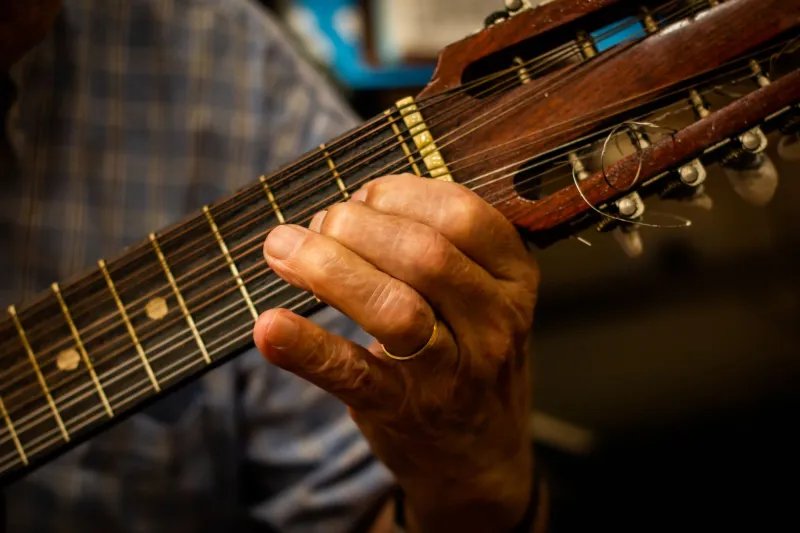
If the right hand is the engine, the left hand is the steering. And Tennant's left-hand work is defined by an almost architectural precision — clean shifts, minimal excess pressure, and a legato approach that makes melodic lines feel genuinely connected rather than strung together.
One of the hallmarks of his playing is how he handles position shifts. Where less experienced players might produce small interruptions in the sound during a shift, Tennant's transitions are nearly seamless. That comes from a deeply internalized sense of timing — knowing exactly when to release pressure and when to reapply it so the musical line doesn't break.
His slur technique (hammer-ons and pull-offs in classical guitar terminology) is also worth noting. Tennant's slurs are even and musical — they don't stick out as technical devices but integrate naturally into the flow of a phrase. That evenness is the product of specific conditioning work, something he's addressed directly in his teaching over the years.
Instrument Selection and Setup
You can't talk about a guitarist's sound without talking about the instrument itself. Tennant has been associated with high-end classical guitars built by respected luthiers, instruments chosen not just for prestige but for specific acoustic properties that complement his technique.
He tends toward guitars with a responsive, articulate treble register — which makes sense given how much of his tonal shaping happens in that range. The bass strings on his instruments are typically warm but defined, avoiding the muddiness that can cloud complex polyphonic passages.
String selection plays into this too. Tennant's choices in string tension and material affect the feel of the instrument under his fingers and the projection of sound into a room. These aren't afterthoughts — they're part of a holistic system where every element of the setup reinforces his technical approach.
Dynamic Range: The Forgotten Dimension
One thing that casual listeners often underestimate is just how wide Tennant's dynamic range actually is. From barely-there pianissimo passages that feel almost private, like he's playing just for himself, to full-throated fortissimo moments with real physical presence — the contrast is dramatic and deliberate.
That range requires control at both ends of the spectrum. Playing very softly without losing tone clarity is genuinely difficult. Playing loudly on a classical guitar without the sound turning harsh or brittle is equally challenging. Tennant navigates both with consistency, which is one reason his recordings hold up under repeated listening — there's always something new to notice in the quieter moments.
Rhythm and Timing: The Subtle Stuff
Finally, there's the rhythmic dimension — the thing that's hardest to teach and maybe the most personal element of any player's identity. Tennant's timing has a particular quality: it breathes. Even in technically demanding passages where the tempo is strict, there's a sense of elasticity in the phrasing that keeps the music from feeling mechanical.
This is sometimes called rubato when it's applied consciously, but in Tennant's playing it feels more organic than calculated. It's the difference between a musician who understands rhythm intellectually and one who has genuinely internalized it at a physical level.
The Bigger Picture
Breaking down Scott Tennant's technique piece by piece is useful, but it's worth stepping back to say: what makes his playing exceptional isn't any single element in isolation. It's the integration. The right hand, the left hand, the instrument, the dynamics, the timing — they all operate as a unified system, each element reinforcing the others.
That kind of integration doesn't happen by accident. It's the product of deliberate practice, serious study, and a career-long commitment to understanding not just what to play, but how and why every technical choice shapes what the listener ultimately hears.
For anyone serious about understanding classical guitar at a high level, watching and listening to Tennant with these elements in mind is genuinely educational. There's a masterclass in every performance — you just have to know where to look.