When the Guitar Becomes a Confessional: Scott Tennant's Radical Honesty Through Six Strings
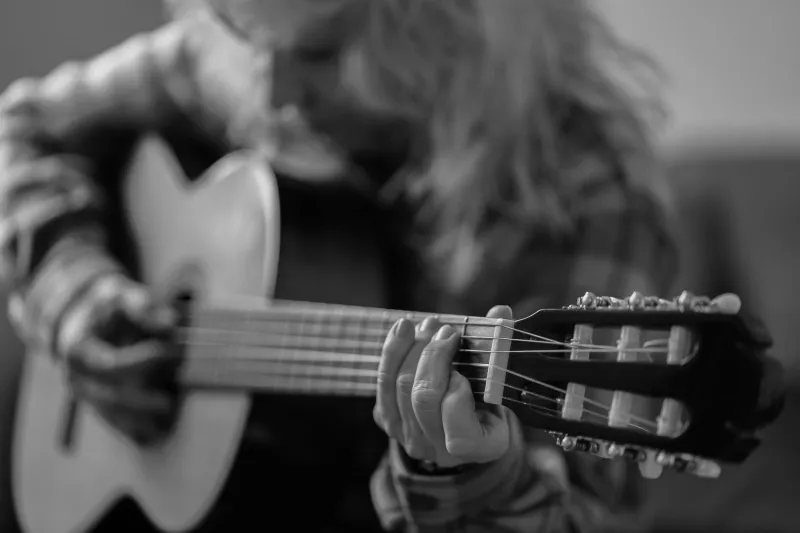
There's a moment in any great performance — and if you've ever been in the room when Scott Tennant plays, you know the one — where you stop thinking about the music entirely. You stop counting the arpeggios. You stop marveling at the speed or the precision. You just feel something, and you can't quite explain why a wooden instrument with nylon strings just cracked something open in your chest.
That's not an accident. That's the whole point.
For Tennant, the classical guitar has never been a trophy case for technique. It's closer to a lie detector — one that exposes what you're actually made of the second you stop performing and start being present.
The Instrument That Doesn't Let You Hide
Here's the uncomfortable truth about the classical guitar that most people outside the concert hall don't fully appreciate: it is brutally unforgiving. Unlike a piano, where the mechanics of sound production are largely hidden inside the instrument's body, the classical guitar demands that every single sound emerge from the direct contact between human fingertip and string. There is no buffer. There is no pedal to sustain a note while you gather your emotions. There is no wall of amplification to paper over hesitation.
What you feel in your hands translates immediately into what the audience hears. Tension in your shoulders tightens your tone. Distraction in your mind creates a fractional delay that a trained ear can detect. Joy — real joy, not performed joy — loosens the wrist and opens up a warmth in the sound that no amount of technical drilling can manufacture.
Scott Tennant has talked about this relationship in ways that go well beyond standard musician-speak about "connecting with the music." For him, the guitar functions as a kind of external nervous system. It registers emotional states with a sensitivity that the human voice, for all its expressiveness, sometimes struggles to match. Words can be chosen carefully. The guitar tells on you.
Technical Mastery as a Clearing, Not a Ceiling
This is where Tennant's philosophy diverges sharply from what a lot of young players are taught to believe. In American music education, there's a tendency to treat technical proficiency as the ultimate goal — the mountaintop. Get the scales clean enough, the shifts accurate enough, the tone consistent enough, and you've arrived.
Tennant flips that entirely. He approaches technique the way a serious athlete approaches conditioning: not as the performance itself, but as the preparation that makes authentic performance possible. You build the physical vocabulary so thoroughly that it stops requiring conscious attention. Then, and only then, does the real work begin.
Think about what that actually means in practice. When a guitarist no longer has to think about where their right-hand fingers are landing, they're free to inhabit the emotional architecture of the piece they're playing. The body knows what to do. The mind and heart can show up.
In his performances of pieces like the Chaconne from Bach's Partita No. 2 — a work that has broken lesser players under its sheer emotional and technical weight — Tennant demonstrates this principle in real time. The technical demands are staggering. But watch his face, watch his posture, watch the way his body breathes with the phrasing. The mechanics are invisible. The humanity is everywhere.
The Psychological Contract Between Performer and Instrument
There's a concept in performance psychology sometimes called the "flow state" — that condition where skill and challenge are so perfectly matched that self-consciousness evaporates and pure engagement takes over. Athletes talk about it. Jazz musicians talk about it. Classical performers, perhaps because their tradition carries so much weight of historical interpretation and scholarly expectation, often struggle to give themselves permission to go there.
Tennant seems to have made a different kind of peace with the guitar. Rather than approaching the instrument as something to be mastered and then presented to an audience, he treats each performance as a genuine conversation — one where he brings his full emotional self to the table and trusts the guitar to translate it honestly.
This isn't mysticism. It's a deeply practical psychological stance. When you stop treating a performance as a test you might fail, and start treating it as a conversation you're genuinely in, the entire quality of your presence changes. The audience feels it. They may not be able to articulate what shifted, but they know something real just happened.
For American audiences in particular — who often come to classical guitar with fewer preconceptions than European concert-goers steeped in centuries of tradition — this quality of raw presence is frequently what creates the most lasting impression. You don't need to know a thing about counterpoint to feel when someone is telling you the truth.
Where Vulnerability Lives in the Repertoire
Not every piece in the classical guitar canon offers equal opportunity for this kind of emotional exposure. Some works are primarily architectural — brilliant, even awe-inspiring, but more about structural beauty than personal revelation. Others crack open like a geode: ordinary-looking on the outside, extraordinary within.
Tennant gravitates, both in performance and in his teaching, toward the works that demand something personal from the performer. The Barrios Mangore nocturnes. The late Dowland fantasies. Certain of the Villa-Lobos Preludes, where the harmonic language is so steeped in longing that a technically correct but emotionally absent performance is almost more unsettling than a messy one played with conviction.
In these pieces, the guitar's tonal palette — its capacity for whisper-quiet intimacy, its sudden warmth in the middle register, the bell-like clarity of harmonics — becomes a kind of emotional vocabulary. Tennant uses it the way a great writer uses word choice: not to show off range, but to say something precise about an interior experience that resists ordinary description.
What This Means for the Rest of Us
You don't have to be a classical guitarist — or a musician at all — to take something meaningful from the way Scott Tennant approaches his instrument. There's a broader principle at work here that resonates well beyond the concert hall.
The guitar, in Tennant's hands, is a reminder that the most powerful communication often happens not through carefully constructed language, but through the honest exposure of what we actually feel. It's a case study in what becomes possible when someone commits fully to transparency — when the performance stops being a performance and starts being a presence.
In a cultural moment where authenticity gets talked about constantly but practiced rarely, that's not a small thing. It's a pretty radical act.
And it happens, night after night, through six strings and two hands and whatever Scott Tennant decides to bring to the room that evening. Which, if history is any guide, will be everything he's got.